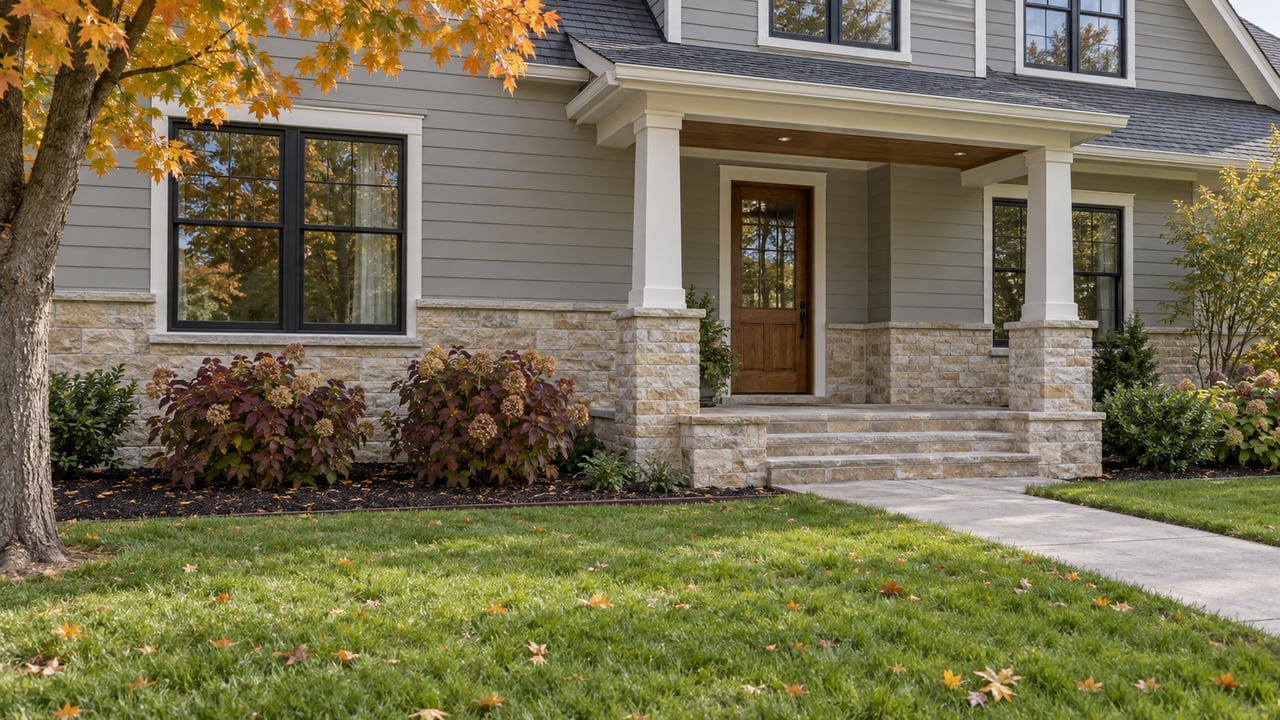
Two homes pop up in your Grafton search at $525,000. Same square footage, same year built, same "Grafton, WI 53024" mailing address. One carries an annual tax bill closer to $6,400. The other lands around $8,400. Neither listing tells you why.
The answer is a municipal boundary that most out-of-area buyers never see on the portals. The Village of Grafton and the Town of Grafton are two separate governments sharing a name, a zip code, and a downtown. They collect different mill rates, hook up to different utilities, and feed into different school districts. Before you write an offer on anything labeled "Grafton," it's worth understanding which Grafton you're actually buying into.
The line that runs through the middle of your search results
The Village of Grafton was incorporated out of the Town in 1896, and the Village has been annexing pieces of the Town ever since. As recently as 1985 the Village covered 2.8 square miles; by 2010 it had nearly doubled to just over 5 square miles as developers requested annexation for access to municipal services. Everything outside those Village limits is still the Town of Grafton, which the 2020 Census pegged at 4,355 residents and which retains a mostly rural and agricultural character stretching east to Lake Michigan and the Lion's Den Gorge Nature Preserve.
Same "Grafton" address. Different tax authority. Here is what that costs, using the 2024 numbers published in the joint Village and Town Economic Profile:
| Where the parcel sits | Net tax rate per $1,000 |
|---|---|
| Village of Grafton, in Grafton School District | $16.02 |
| Village of Grafton, in Cedarburg School District | $14.89 |
| Town of Grafton, in Grafton School District | $12.08 |
| Town of Grafton, in Cedarburg School District | $10.93 |
| Town of Grafton, in Port Washington-Saukville School District | $11.82 |
On an assessed $500,000 home, moving from a Village parcel in Grafton schools to a Town parcel in Cedarburg schools cuts the annual bill by more than $2,500. That is a real payment difference, and it is invisible on the MLS card.
What the tax gap is actually paying for
The Village provides sewer and water. Cross into the Town and, in most cases, the buyer takes on a private well and a private onsite wastewater treatment system, known in Wisconsin code as a POWTS. The lower mill rate is not free money. It is a shift in cost and responsibility from the municipality to the homeowner.
That shift affects three parts of the transaction. First, the inspection scope. Wisconsin DNR rules under NR 812 do not technically require a well inspection at property transfer, but many lenders do, and if an inspection is performed it must be conducted by a licensed water well driller or licensed pump installer, not a general home inspector. That inspection automatically triggers water testing for coliform bacteria, nitrate, and arsenic through a certified laboratory. Arsenic in eastern Wisconsin groundwater is not hypothetical, and the state added arsenic to the mandatory panel through formal rulemaking specifically because it was showing up in more counties than originally assumed.
Second, the negotiation form itself changes. On a Town parcel with a well or POWTS, the Wisconsin REALTORS® Association Addendum B typically comes into the offer. It sets the standards for what happens if the initial water sample comes back bacteriologically unsafe: the seller may shock-chlorinate the well and retest up to two times, with the buyer's report deadline and the closing date each extendable by up to 14 days. Two safe reports are required to satisfy the contingency after any bacterial hit.
A Village buyer negotiates over paint and appliances. A Town buyer can find themselves negotiating over a 14-day closing extension because a well retest is pending.
Third, the seller disclosure exposure is broader. The Real Estate Condition Report required under Wis. Stat. Chapter 709 asks the seller to disclose knowledge of well defects, unsafe well water, improperly closed wells, joint well agreements, the existence of a septic or private sanitary system, septic defects, backups, ponding, and any out-of-service systems not properly closed. A Village seller checks "not applicable" on most of those. A Town seller cannot, and any known issue moves onto the form or opens the seller to a claim later.
The third variable nobody sees on the listing
School district assignment inside Grafton is not one-to-one with the municipal line. The Village of Grafton is served by both the Grafton School District and the Cedarburg School District. The Town of Grafton splits three ways: Grafton, Cedarburg in the southwestern part, and Port Washington-Saukville in the northeastern part. The Grafton district runs Kennedy Elementary and Woodview Elementary for kindergarten through fifth grade, then John Long Middle School and Grafton High. Grafton residents assigned to Cedarburg schools attend Thorson Elementary.
For a relocating family that has been comparing school data at the district level, this matters. Two houses on the same road can feed different elementaries. It is worth pulling the parcel and confirming the attendance area before assuming the district that appears on a listing summary is the one that will apply.
How this plays out on current inventory
The new-construction map makes the split concrete. Hawks Ridge, a Village subdivision near Keup Road and Highway 60, markets its municipal sewer and water hookup as a selling point and sits in the Grafton School District, with some phases in Cedarburg schools. Shady Hollow, also in the Village, sits near Pleasant Valley Road with quick access to I-43 and downtown Cedarburg. Country View Subdivision is in the Town of Grafton, offering roughly 1-acre homesites where the well and septic tradeoff is the price of the land size and the lower mill rate. Creekside Estates, close to the border with Cedarburg, feeds into Cedarburg schools even at a Grafton mailing address.
The Village side also carries fixed infrastructure that shapes daily life: Aurora Medical Center Grafton opened in 2010 and is the community's largest employer, and the Route 143 Ozaukee County Express commuter bus makes park-and-ride stops at the Grafton Commons shopping center and the Target parking lot off Exit 92 for buyers commuting to Milwaukee. Town parcels are farther from those anchors by design.
What to check before you write the offer
- Pull the parcel on the Ozaukee County GIS map and confirm Village or Town. A "Grafton, WI 53024" address is not proof of either.
- Confirm the assigned elementary school with the district office, not the listing remarks. In the Town, ask which of three districts applies.
- If the parcel is in the Town, ask the listing agent whether the water source is a private well, a shared or joint well, or a rare municipal connection extended by annexation. Joint well agreements have their own line on the Real Estate Condition Report for a reason.
- Budget for the licensed well inspection and the coliform, nitrate, and arsenic panel as a separate line item from the standard home inspection. A general inspector cannot legally sign off on the well itself at transfer.
- On any Town property, ask when the POWTS was last inspected and pumped. Wisconsin's maintenance regime is three-year, and lender-required transfer inspections tend to be more thorough than the routine three-year check.
FAQ
Does the Village or the Town get more inventory in a typical month? Historically the Village carries more active listings because it holds more of the housing stock and most of the newer subdivision development. Village annexation activity has been steady enough that the boundary keeps moving toward the Town over time.
Can a Town parcel be annexed into the Village later to gain sewer and water? Yes, and the Village has continued to accept annexation petitions from owners and developers seeking access to municipal services. It is a process rather than a guarantee, and it usually resets the tax obligation at the higher Village mill rate once complete.
Is a lower Town tax bill actually a savings once you add well and septic costs? Sometimes, over a long hold. A well pump replacement, softener system, or POWTS repair can consume several years of tax savings in a single event. The right way to compare the two is a fully loaded annual cost of ownership, not the mill rate alone.
If you are weighing a specific "Grafton" listing and want a clear read on which side of the line it sits on, what that means for your monthly carry, and what the disclosure and inspection path will look like on that exact parcel, Realty Officials can walk the property with you and put real numbers next to the listing. Request a complimentary market valuation and we will build the comparison before you write the offer.